Multiply yourself.
A local-first desktop app for running AI agents — Claude Code, Codex, Cursor, or your own — with full visibility into every step. Bring your own keys. Free forever.
Free with your own keys · $12/mo to sync across devices · No card required
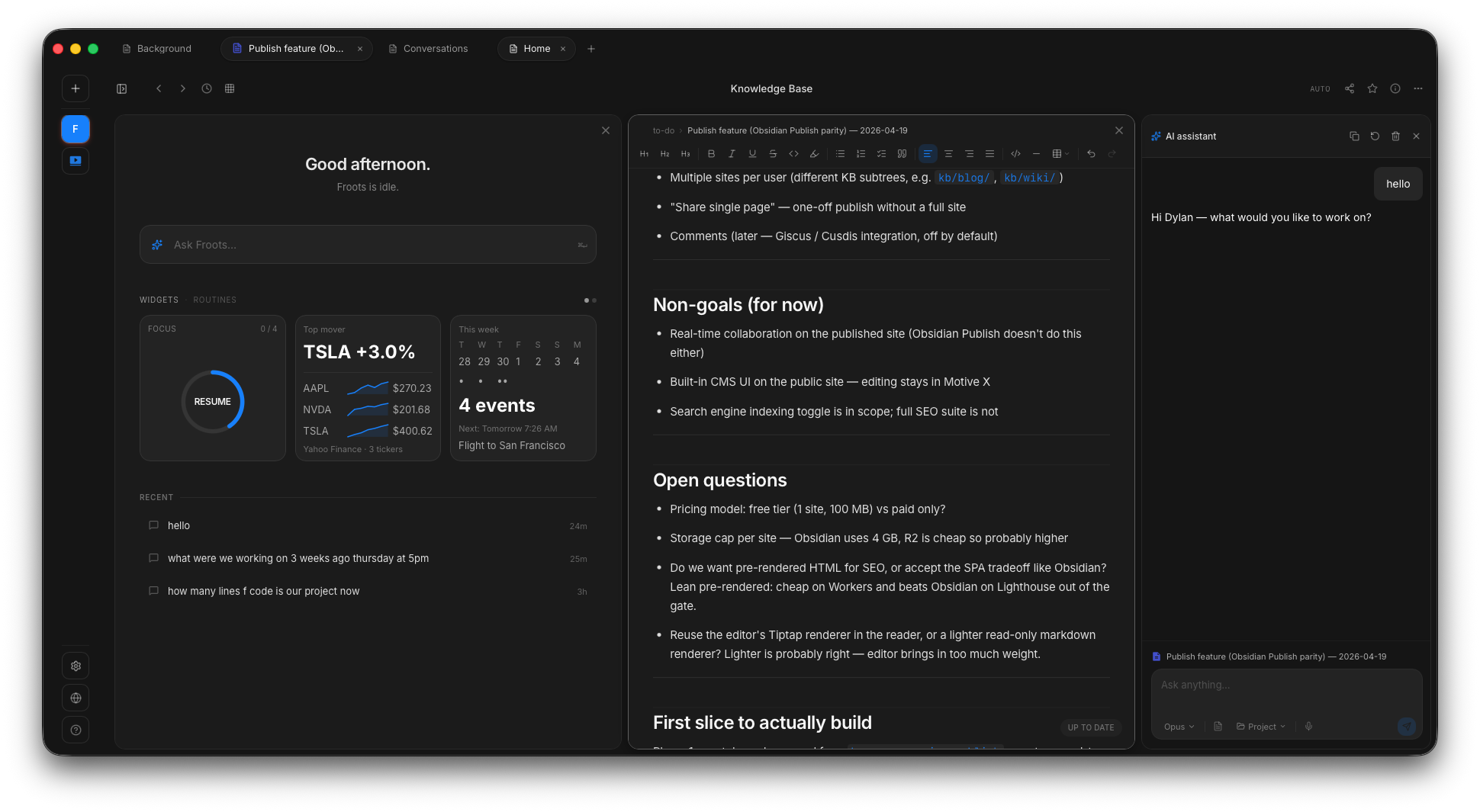
What can I run on Froots?
Bring any agent harness, give it the tools it needs, and watch it work. A few of the things teams ship today.
Coding agents
Plug in Claude Code, Codex, Aider, or your own harness. Watch tool calls and diffs in real time, approve risky edits, and ship without losing the plot.
Browser automations
Hand the agent a browser and a task. Froots renders the live session, captures every click, and lets you intervene when it gets stuck.
Research agents
Multi-step research, market deep-dives, and technical surveys with citations. The agent does the legwork; you read the brief.
Sales & outbound
Source leads, enrich them, draft outreach in your voice, and log everything to your CRM — all from a run you can audit line by line.
Data extraction
Point an agent at a site and get clean, structured data back. No scrapers, no brittle selectors — the run is the spec.
Customer support
Triage tickets, draft replies grounded in your KB, and route the hard ones back to a human — with a transcript of every step.
Ops & internal tools
Morning briefs, weekly reports, scheduled cleanups. Give an agent the tools and a cron, then forget about it (until something interesting happens).
Marketing & content
Competitor tracking, content drafts, scheduling — agents handle the busywork while you keep editorial control over what ships.
Evals & QA
Run an agent across a dataset, replay any case, and diff outputs between harnesses or model versions to see what actually got better.
Personal assistant
Your calendar, your messages, your notes, your smart home — driven by one agent that knows your schedule and your taste.
Knowledge base
Turn your scattered docs, meetings, and notes into a searchable second brain. The vector store does the indexing; you keep editing markdown.
Voice & audio agents
Transcribe meetings, summarize calls, generate voice notes — turn audio into text the rest of the system can act on.
Watch your agents work
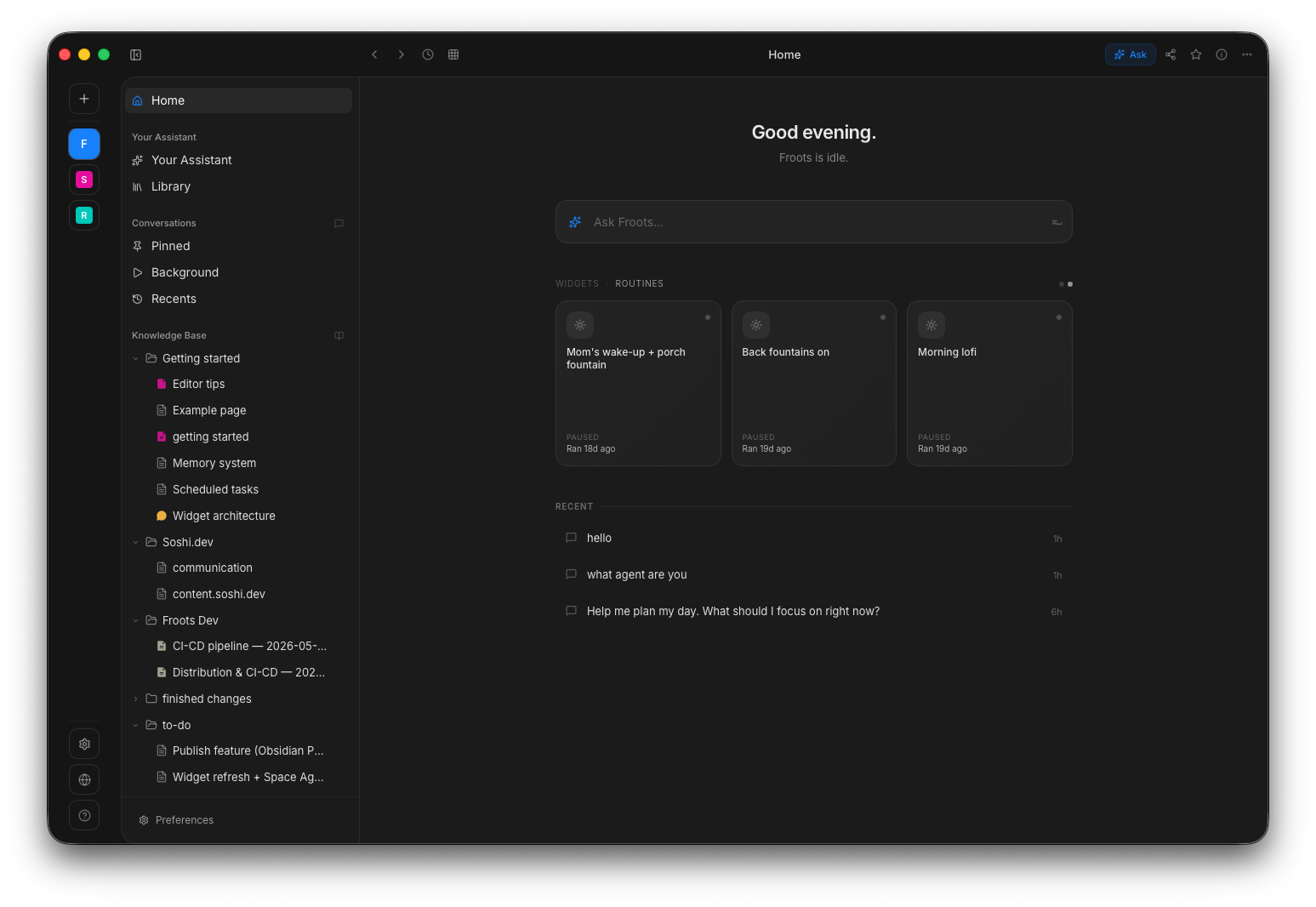
Any model. Any harness.
Froots is model-agnostic — pick the brain that fits the job. Click any card for pricing and capabilities.
- Claude Opus 4.7
Top-tier reasoning for long agent runs and complex tool use.
StreamingVisionFunctions#frontier#reasoning - Claude Sonnet 4.6
Balanced flagship — fast enough for chat, smart enough for agents.
StreamingVisionFunctions#balanced#agentic - DeepSeek V3
Open-weight reasoning model — frontier benchmarks at a fraction of the price.
StreamingFunctions#open-weight#cheap - Gemini 2.5 Pro
Long-context multimodal model with search and code execution.
StreamingVisionFunctions#long-context#multimodal - Llama 4 405B
Open-weight flagship — run hosted or on your own GPU. No vendor lock-in.
StreamingFunctions#open-weight#self-host - GPT-5
Multimodal flagship with strong reasoning and structured tool use.
StreamingVisionFunctions#frontier#multimodal
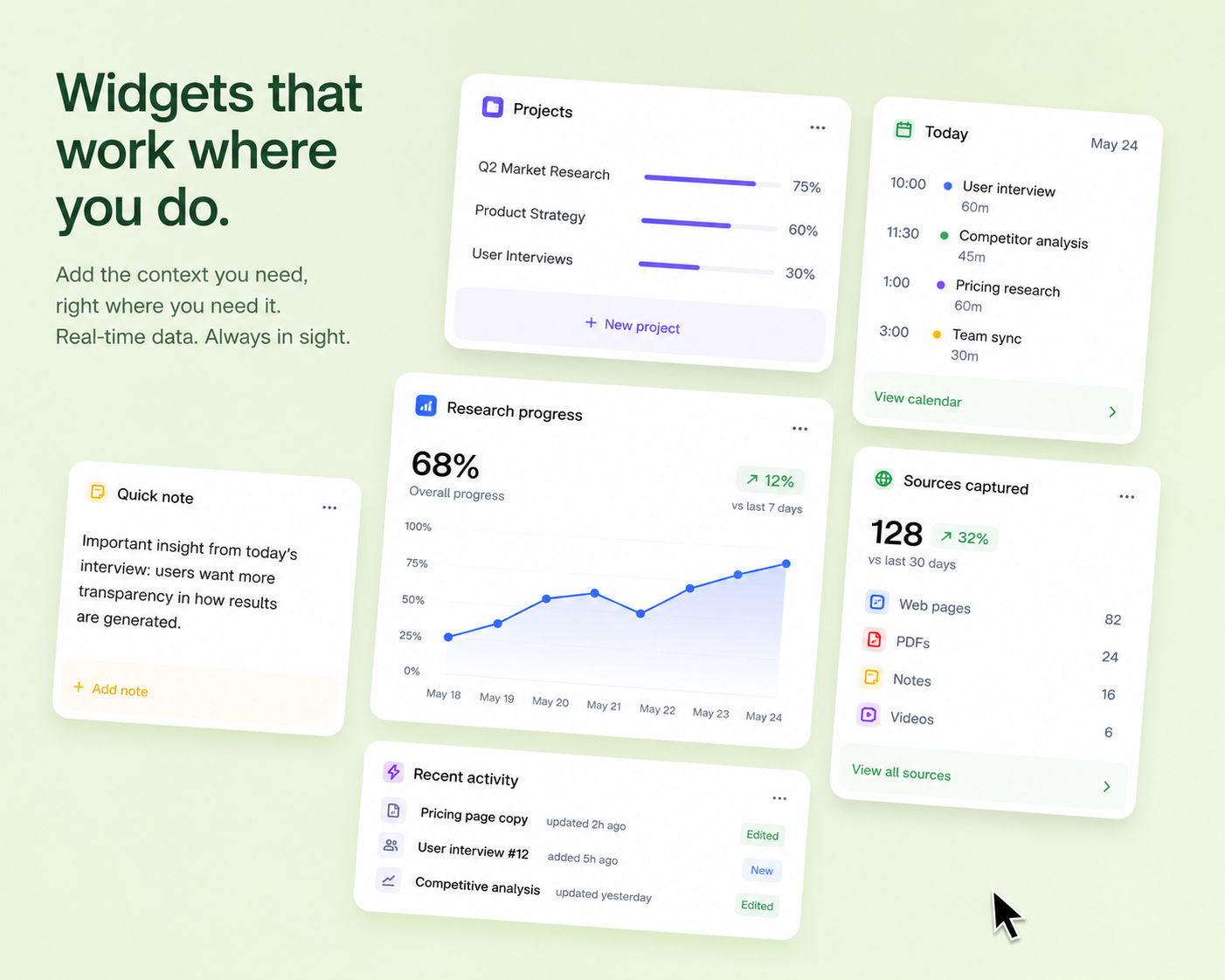
Custom views for your internal ops
Spin up dashboards, widgets, and panels tailored to how your team actually works. Pin them to your desktop, share them with your agents, and stop tab-hopping between five different tools.
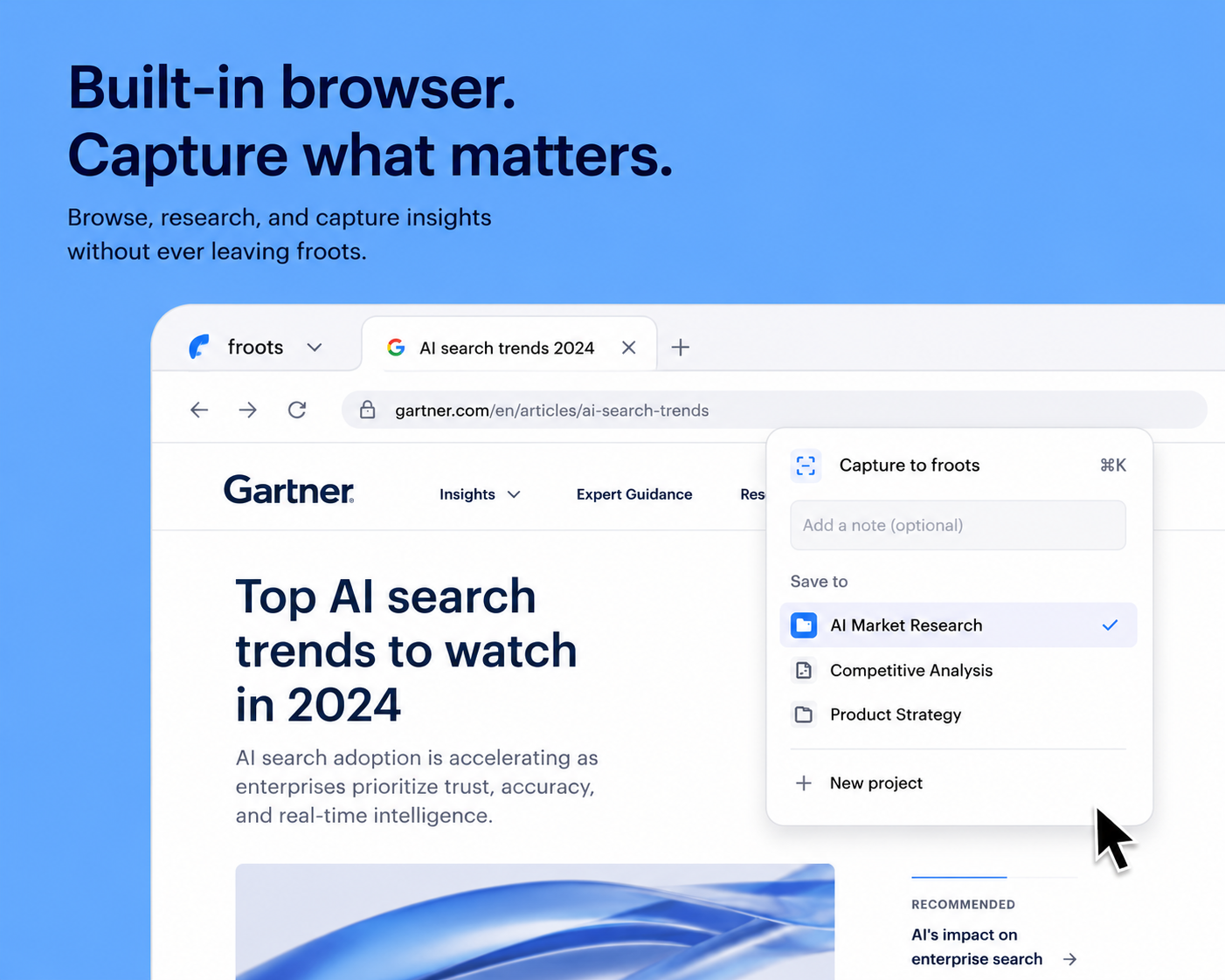
A browser, built in
Research, prospect, and pull data without ever leaving Froots. The built-in browser lives next to your agents, so what they see is what you see — and either of you can take the wheel.
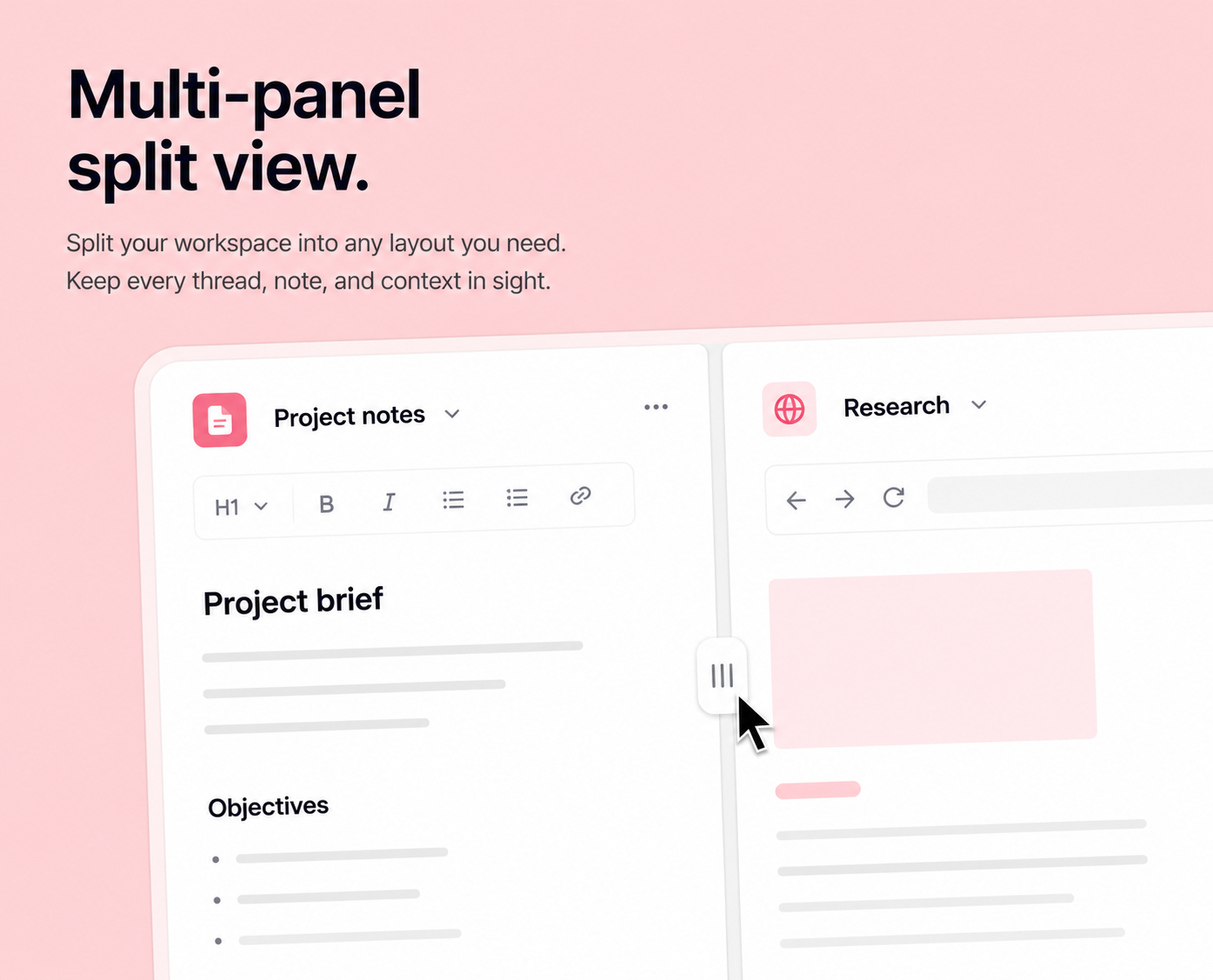
Multi-panel for multi-agent workflows
Run several agents side by side — one drafting, one researching, one shipping. Each gets its own panel, its own context, its own tools, while you orchestrate from a single canvas.
Works with your stack
Connect Froots once, then every agent and tool you use knows your context instantly.

Frequently asked
The stuff people ask before they sign up.
Froots is a local-first desktop app where you run AI agents — Claude Code, OpenAI Codex, Cursor, or your own harness — and watch every move they make. Tool calls, file diffs, browser sessions, memory updates, and reasoning all stream into one timeline you can pause, fork, and replay. You bring the model keys; your data stays on your machine.
Claude Code, OpenAI Codex, Cursor agents, and your own homegrown harness. We speak to each through a thin adapter so the interface and controls stay identical regardless of who's driving.
Shell, browsers, MCP servers, your private APIs, and anything you can wrap in a function. Wire a tool into a run with a few lines of config — agents call it, you see exactly what they did.
Yes. Every run is fully interruptible. Pause anything risky before it touches prod, review the diff, and either approve, edit, or kill the run. You stay in the loop on the steps that matter.
Your runs, memory, and knowledge base stay on your machine by default. Bring your own model keys; we never see your prompts or outputs unless you opt in to cloud features.
Chat UIs show the conversation. Froots shows the work — tool calls, file diffs, browser sessions, memory updates, and reasoning all streamed into one timeline you can replay and fork.
No. The starter routines, widgets, and skills work out of the box. If you're a developer, you can write your own skills and harness adapters — but most teams ship without writing code.
Free forever when you bring your own model API keys (Claude, GPT, Gemini, Ollama, local). $12/mo if you want to sync your vault and memory across devices. Beta pricing locked in for life. See /pricing for full details.